

ILEC is seeking expressions of interest from regions worldwide to host the upcoming WLC.
Why Host a WLC?
The WLC will bring together global experts, policymakers, citizens, and the private sector to discuss critical issues on lake basins worldwide. Hosting the World Lake Conference offers interesting and attractive experiences for your institution and the surrounding region, including the following:
- International recognition and contribution: Your intention to contribute to sustainable lake management will be widely recognized and appreciated nationally and internationally.
- Community Engagement: Hosting a WLC can be an excellent opportunity for inspiring and enhancing the involvement of your local community to benefit from and contribute to addressing local and global environmental issues.
- Strengthened Networks and Partnerships: Convening WLCs can help the host organization community to strengthen the existing networks as well as help develop new networks with international organizations, governmental bodies, and research institutions.
How to Submit a Proposal
The selection of the host of WLC is typically considered about three years prior to the event.
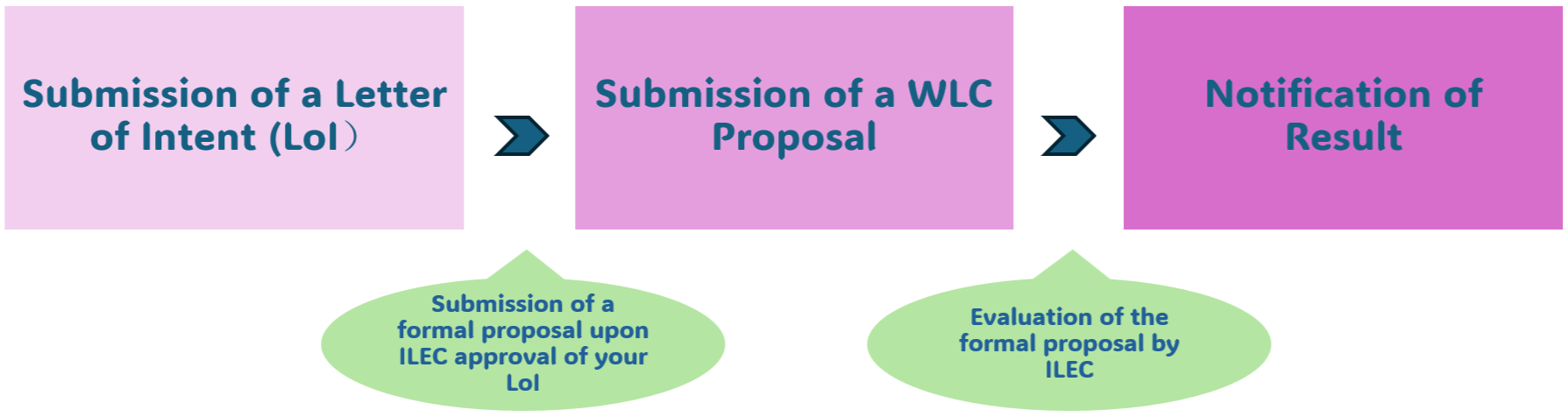
The submission, evaluation and eventual selection of the successful convener of the WLC host comprises the following two steps:
- Submission of a Letter of Intent (LoI)
- Submission of a WLC Full Proposal.
Letters of Intent (LoI) and Full Proposals to host WLC will be duly evaluated by ILEC (Scientific Committee, the Board, and Secretariat with participation of ILEC requested external evaluators, if so needed).
Submission, Evaluation and the Final Notification Process
Submission of a Letter of Intent (LoI) to Host WLC
To submit a Lol, please fill in the LoI form from the link: https://forms.gle/VFFLZMJkp11NDFU77
- Required Information
- Proposed WLC Period
- Proposed Host Location (city and country, including the name and location of the proposed venue/facility)
- Conference Concept/Theme
- Name of Host Organization(s)
- Name of Contact Person
- Number of Anticipated Participants
- Feasibility for Hybrid (on-site and remote) Events
- Current status of endorsement and support from your local and national governments, and prospects for such support if selected as the WLC host
- Current status of collaboration with academic institutions and research institutions supporting your proposal, and prospects for expanding such collaboration if selected as the WLC host
- Prospective Financial Sponsors
- Typical World Lake Conference program:
- Thematic Sessions (Oral and Poster)
- Keynote Presentations
- International Policy Forum/National or Regional Policy Forum
- Relevant Workshops
- Youth Session
- Exhibition Booth
- Field Trip
- Cultural Events
- Banquet
- Other Programs
- The following information would be helpful to include in the comments section of the Letter of Intent (LoI):
- Experience in organizing international conferences (if available, please give examples)
- Reasons for wishing to organize the conference, goals, desired outputs, etc.
- Self-assessed superiority in successfully convening the WLC
Organizations submitting Letters of Intent (LoI) to host the WLC should submit a Full Proposal by the designated date after the approval of the LoI is notified.
Submitting a Full Proposal to Host WLC
ILEC will study the submitted LoI and interact with the proposing organization for possible submission of a Full Proposal.
Organizations desiring to host the World Lake Conference should address the following matters in their Proposal:
- State the local organizers' capacity and experience in developing and hosting an international conference, including arranging venues, helping develop the conference program, identifying keynote speakers, organizing attractive social events, and providing a hybrid-mode conference (with both in-person and online participation).
- State the prospective support to receive from science, government, and community organizations in the proposed host country and region. It is desirable for the proposal to include letters of support from national or regional organizations, such as government agencies, universities, scientific academies, industry, and local groups.
- State the level of accessibility and convenience for participants and the proposed conference facilities are attractive and suitable for a conference of 300+ registrants. (Previous conferences have ranged from 300 to 1500 delegates.)
- State the level of assurance to take responsibility for all financial aspects of the conference.
- Presents a draft budget outlining the main costs and anticipated income for the conference, including registration fees.
- State if and how the delegates from developing countries and students might be supported to participate in the conference (e.g., offering reduced registration fees).
WLC Hosting: Roles, Responsibilities, and General Requirements After Selection
The following outlines the roles, responsibilities, and general requirements that apply to the organization selected as the WLC host for organizing and hosting the WLC. These should also be taken into consideration when preparing the full proposal.
Responsibilities of the WLC Local Host
- Establishing the WLC Organizing Committee.
- Coordinating and implementing all logistical aspects connected with the conference organization.
- Management of the conference finances and budget.
- Coordinating and implementing advertising and promotion of the conference.
- Coordinating and implementing the conference social program.
- Coordinating and implementing the conference social program.
- A theater-style main plenary hall capable of accommodating all conference participants is required.
- Meeting rooms with equipped video projectors, sound systems, and internet access are required to accommodate parallel sessions ( theatre or classroom set-up).
- A room or hall for lunch breaks and the conference reception is needed.
- Providing necessary audiovisual equipment, including a simultaneous interpretation system if needed.
- Providing and managing the conference registration system, including credit cards and other electronic payments of the conference fees.
- Providing and managing the content of the conference website, including information about the conference venue, hotels, transport, registration, program, call for abstracts, etc., and updating the website as needed.
- Coordinating with invited speakers on their participation, travel, accommodation, other conference support, etc.
- Providing invitations and other necessary support to participants requiring visas.
- Prepare the conference proceedings and a report promptly after the conference is completed. They will be published on the ILEC and the conference websites.
- Producing WLC’s main visuals:
- Conference logo and posters.
- Publicity materials (flyers, programs, website, etc.), to include the conference logo and the logos of the local host organization and ILEC.
- The conference Logo should follow previous editions of the WLCs.
Responsibilities of ILEC
- Assisting in overseeing the conference organization and program, ensuring the signed Memorandum of Understanding (MoU) with the Local Host is respected, as well as other agreed-upon terms.
- Assigning the ILEC Scientific Committee Members to join the WLC Organizing Committee following its formation, which will:
- Issue the call for abstracts, evaluate the abstracts, and decide on the final themes of the thematic sessions.
- Decide on the invited speakers and other program elements.
- Contact the selected speakers and invite them to the conference.
- Providing conference information on the ILEC website and social media to advertise and promote the conference.
- Promotion of participation in the conference through ILEC’s international network.
- Providing session chairs and keynote speakers from the ILEC Scientific Committee as appropriate.
- Coordinating with the Local Host on various matters related to planning and operations for WLC.
Finances
- The Local Host is fully responsible for managing the conference finances and budget, including incoming revenue, expenses, sponsorships, reimbursements, etc. At the conclusion of the conference, the Local Host will ensure all reimbursements and invoices are settled. The Local Host will also provide ILEC with a final financial report.
- The registration fees proposed during the proposal evaluation shall not be changed significantly without prior consultation with ILEC.
- The Local Host is responsible for all fundraising efforts. Sponsorship packages or funding cases are developed by the Local Host in consultation with ILEC before being made public.
- The Local Host shall receive all revenues and bear all losses arising from the organization of the conference.
Changes, Delays, Cancellation and other Generic Aspects
- Any changes to the conference arrangements must be discussed between ILEC and the before implementation, assuming mutual agreement shall be reached.
- The Local Host cannot change the venue, term, or other logistical aspects that hinder the already agreed-upon conference program. If there is an absolute need for changes, they shall be discussed and acted upon by the parties.
- Should the conference not be implemented as agreed in the formally settled MoU (e.g., dates because of unforeseeable circumstances), ILEC and Local Host shall discuss the feasibility of delaying it. Considerations for delaying the conference must include the safety of the participants and financial and/or reputational impacts on ILEC, the Local Host, and/or conference participants.
- Any decision to cancel the conference under any circumstances will be made only after ILEC and Local Host have reached a discussion and agreement. All parties will make all efforts to identify alternative means by which the conference may proceed in place of its cancellation, including delays.
- The working language of WLC is English. Local language speakers are allowed and welcomed, depending on the nature of the program. In the case of formal sessions, simultaneous interpretation in English should be provided.